
Microsoft Security Essentials (Windows Defender on Windows 8) was
once on top. Over the years, it’s slid in the test results, but
Microsoft argued the tests weren’t meaningful. Now, Microsoft is
advising Windows users to use a third-party antivirus instead.
This revelation comes to us from an interview Microsoft gave.
Microsoft’s official website still bills MSE as offering “comprehensive
malware protection” without any hint that they no longer recommend using
it. Microsoft is not communicating well with its users.
A Strong Start
Microsoft Security Essentials was once on top of the rankings. In 2009, AV-Comparatives.org gave it a very high score and said it was the best-performing free antivirus.
MSE was very appealing to Windows geeks like us, who quickly latched
onto it. It received very good malware detection scores, was extremely
speedy, and was free. Not only was it available for free — it wouldn’t
hassle you and try to upsell you to paid antivirus solutions, like AVG
and avast! do. MSE was a breath of fresh air — both in its interface and
its speedy performance. Its test results showed it was ahead of the
pack, so it was best antivirus at the time.
We’ve been recommending MSE as the free antivirus to use for years
because of this. It’s included by default on Windows 8 and named
“Windows Defender.” This is one of the big security improvements in Windows 8
— you have an antivirus included so every Windows user has protection.
It would be nice if Windows users finally didn’t have to seek out a
third-party antivirus.
Sliding Scores and Excuses
Over the past several years, Microsoft Security Essentials has slid
in the malware detection scoring tests. AV-TEST’s 2011 annual review
ranked Microsoft Security Essentials last place in protection among all
the products it tested. In October 2012, Microsoft Security Essentials
scored so low that it lost its AV-TEST certification. In June 2013, MSE
received a zero protection score from AV-TEST — the lowest possible
score. It’s also come last in other recent tests, including one by
Dennis Technology Labs.
The below chart shows MSE at the bottom of AV-TEST’s charts for July and August 2013. When it comes to malware protection, it tested below every other antivirus program tested.
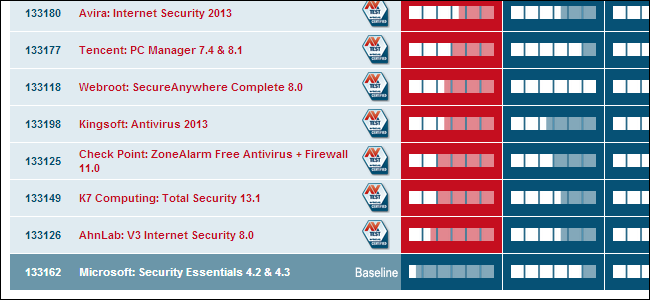
At the time, Microsoft argued that the tests were not representative of the real world.
They said they were focused on trying to stop real-world threats, not
compete in tests where the detection of rare malware was a significant
factor. They argued that avoiding false positives was an important goal
and that real-world experiences were more important than arbitrary test
results.
Geeks like us here at How-To Geek believed them, taking them at their
word. We certainly had used Microsoft Security Essentials on our
personal computers for years. We hadn’t encountered any malware, even
after performing scans with other antivirus programs to get a second opinion. We liked Microsoft Security Essentials for being so lightweight, unintrusive, and not trying to upsell us to paid security suites full of system utilities we don’t need.
We liked the idea that Windows 8 users wouldn’t need any additional
antivirus protection, eliminating another complicated system tool from
Windows users’ lives.
Microsoft Has Stopped Trying
The Microsoft Security Essentials website promises “comprehensive
malware protection” and “award-winning protection,” so users would be
forgiven for believing that Microsoft was committed to making MSE a
capable antivirus solution. But Microsoft is now saying that MSE is only
basic protection that users shouldn’t rely on.
In an interview with Dennis Protection Labs,
Holly Stewart, the senior program manager of the Microsoft Malware
Protection Center, said that Microsoft Security Essentials was just a
“baseline” that’s designed to “always be on the bottom” of antivirus
tests. She said Microsoft sees MSE as a first layer of protection and
advises Windows users to use a third-party antivirus instead.
According to Holly Stewart, Microsoft “had an epiphany a few years
ago, back in 2011, where we realised we had a greater calling and that
was to protect all Microsoft customers.” She says that Microsoft passes
its information on to other antivirus makers and helps them make their
products better. “We used to have part of our time directed towards
predicting test results,” but these people have now been directed to
focus on emerging threats and share that information with other
antivirus companies.
She went on: “We’re providing all of that data and information to our
partners so they can do at least as well as we are. The natural
progression is that we will always be on the bottom of these tests. And
honestly, if we are doing our job correctly, that’s what will happen.”
Nevertheless, she argues that “baseline does not equal bad” and says
they provide a high-quality antivirus. But Microsoft themselves are
recommending users not use MSE, so it’s hard to take that seriously.
This isn’t a product average people should use — it’s better than no
antivirus, but not something we should recommend. Microsoft is doing a
disservice to its users by telling antivirus testing companies that they
don’t recommend MSE for average users and telling average users that
MSE provides them with “comprehensive malware protection” on their
website. Microsoft needs to pick one message and stick to it.

If You’re a Geek, You Can Get By With MSE
Now, if you’re a geek like we are, MSE and Windows Defender are very
usable. If you have good security practices and know what you’re doing,
you can manage just fine with this lightweight option. But average
Windows users don’t always follow proper security practices and should
use a strong antivirus that does well in tests — as Microsoft themselves
now recommend.
If you’re a geek, you probably shouldn’t recommend MSE to your
friends or install it on your parents’ computer. Yes, it’s a shame —
MSE’s lightweight and hassle-free nature make for a great interface and a
faster computer. But the core of an antivirus is the detection engine,
and Microsoft appears to be throwing in the towel here.

So What Should You Use?
To find an antivirus product that actually offers good protection, consult an antivirus test website
and see how your antivirus of choice stacks up. Luckily, one thing
hasn’t changed in the latest test results: We still don’t recommend
purchasing a paid antivirus because there are solid free options.
avast! Free Antivirus
has done well in tests, offering comprehensive and free antivirus
protection. Unfortunately, it’s heavier than MSE, its interface is more
overbearing, and it tries to upsell you to a paid product you don’t
really need. But that’s the price we pay for solid antivirus protection.
For average users — not geeks who can get by with the minimum
protection — we’d recommend avast! Free Antivirus.


0 comments:
Post a Comment